
Safeguarding Tan Trao’s forest heritage
The special-use forest of Tan Trao, covering more than 4,000 hectares, is not only the “green lung” of the former revolutionary base but also an emerging eco-tourism destination thanks to its pristine landscape and rich biodiversity. According to the Forest Protection Unit of Zone I, Tan Trao is home to 734 plant species belonging to 456 genera and 143 families, including 26 species listed in Vietnam’s Red Book such as Tau mat, Giao co lam, and Sen mat. Its fauna is equally diverse, with 33 mammal species, including the masked palm civet, small-toothed palm civet, wildcat, tufted flying squirrel, and pygmy slow loris - clear signs that the forest’s natural structure remains well preserved.
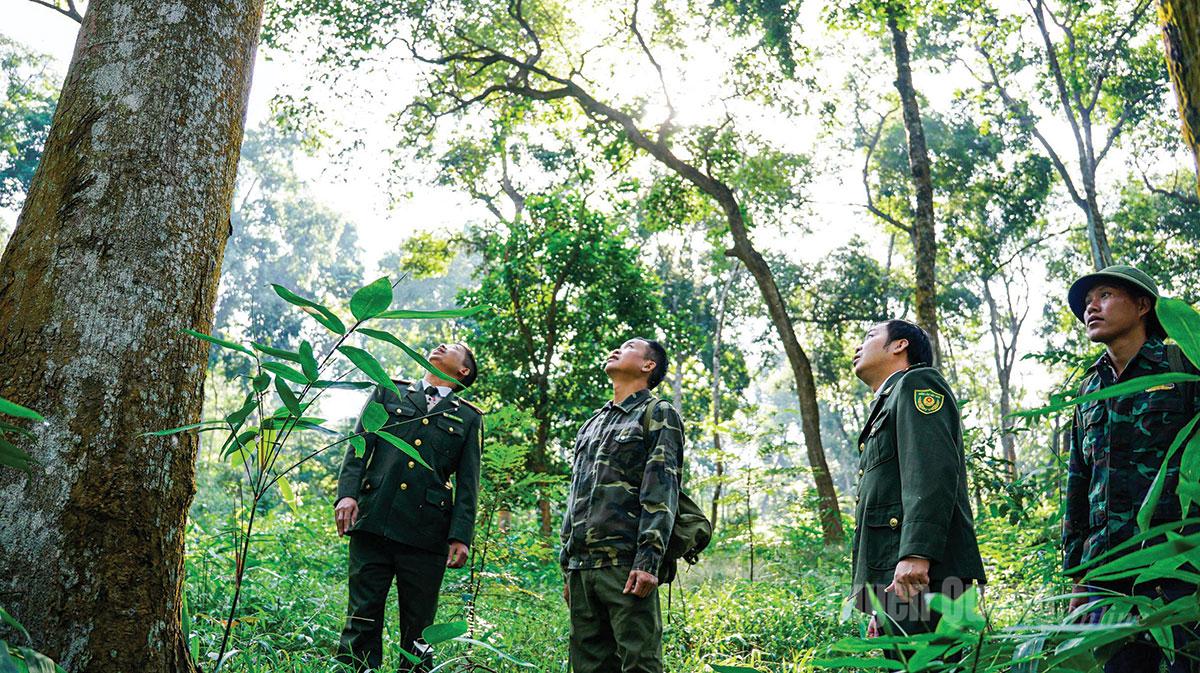 |
| Tan Trao possesses many ancient trees with hundreds of years old. |
The forest shelters towering ancient trees like gu huong, nghien, and lim xanh, alongside unique native species such as the purple phach and yellow-blossomed lim xet. Beneath the canopy lies a “treasure trove” of medicinal herbs, including giao co lam, sam cau, and thien nien kien, offering both ecological and economic value.
Forest protection relies heavily on local communities. In Tan Lap village, each household manages nearly 30 hectares and participates in monthly patrol rotations. Protecting the forest is viewed as both a duty and a long-standing emotional bond. State-funded forest protection contracts provide additional income and strengthen residents’ sense of responsibility. Communication efforts are carried out through village meetings and social media, while forest protection teams regularly remind locals not to bring fire into the forest during the dry season.
Despite the challenges of a vast, mountainous terrain, digital transformation has improved management. Technologies such as GIS, GPS, digital maps, and forest resource databases help rangers monitor boundaries and forest changes more effectively.
For the people and forest rangers of Tan Trao, protecting the forest means safeguarding life, preserving historical relics, and supporting sustainable tourism. As the forest remains green and water sources are abundant, tours such as the two-day trek to Hong Peak attract increasing numbers of visitors, contributing to local livelihoods and preserving this “green heritage” for future generations.
Le Duy


READER COMMENTS